Across China: "King of Dinosaurs" visiting Beijing in historic Chinese mainland debut

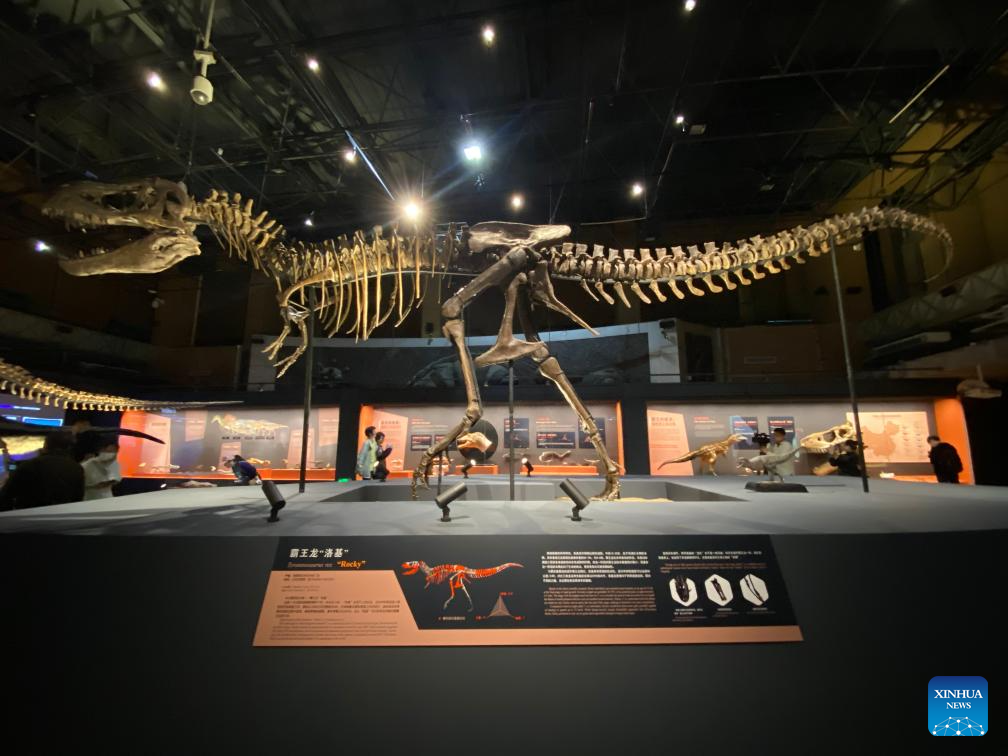
This photo taken on April 28, 2026 shows a reconstructed skeleton of Tyrannosaurus rex named Rocky at the "A Special Exhibition for the King of Dinosaurs" at the Natural History Museum of China in Beijing, capital of China. "A Special Exhibition for the King of Dinosaurs," a blockbuster event that pairs two authentic Tyrannosaurus rex (T-rex) skeletons from Germany with an unprecedented gathering of China's own ferocious tyrannosauroids, has opened at the Natural History Museum of China in Beijing. The show runs through Oct. 11. (Xinhua/Luo Xin)
BEIJING, May 1 (Xinhua) -- The "king of the dinosaurs" has arrived in Beijing. Notably, it didn't come alone.
"A Special Exhibition for the King of Dinosaurs," a blockbuster event that pairs two authentic Tyrannosaurus rex (T-rex) skeletons from Germany with an unprecedented gathering of China's own ferocious tyrannosauroids, has opened at the Natural History Museum of China in Beijing. The show runs through Oct. 11.
This marks the first time ever a T-rex skeleton is being displayed in the Chinese mainland. More significantly, it's the first time North American tyrannosaurs and their Chinese cousins have stood side by side, offering visitors a rare, continent-spanning look at the lineage that produced the most famous predator ever to walk the Earth.
At the beginning of the 20th century, the first T-rex skeletal fossil was discovered in the United States and subsequently named "Tyrannosaurus rex," the top land predator from the Late Cretaceous period of the Mesozoic Era (approximately 68 to 66 million years ago).
"We are using the latest scientific research achievements to reshape the real image of the T-rex," said Zhang Yuguang, deputy director of the Natural History Museum of China.
More than 85 percent of the over 100 precious exhibits at this event are fossils, but the stars of the show are two genuine fossils from Germany's Dinosaurier Museum Altmühltal: a juvenile named Rocky and an adult dubbed Regina.
Rocky, discovered in the late 1990s, is nearly 10 meters long and boasts an astonishing completeness rate of over 60 percent, placing it among the top 10 most complete T-rex skeletons in the world.
Regina stretches more than 12 meters from nose to tail. Based on her massive femurs rivaling those of the famous Sue, which is the largest, most complete and best-preserved T-rex skeleton ever discovered, researchers estimate that Regina may weigh over 10 tonnes.
"Real T-rex skeletons are on display here on Chinese soil together in a country with an incredibly rich fossil record and immense enthusiasm for dinosaurs," said Nizar Ibrahim, an expert with University of Portsmouth at the exhibition.
Inside the main hall of the museum in Beijing, the scene was electric. Children pressed their noses against glass barriers, eyes wide, as Regina's 1.3-meter skull, lined with serrated, banana-sized teeth, loomed overhead.
Nearby, paleontologists and volunteers stood ready to answer rapid-fire questions: Could a T-rex really run fast? Did it roar like in the movies?
Yet what makes this exhibition truly unique is what stands alongside Rocky and Regina, namely almost 400 million years of Chinese predatory evolution. For the first time, China's entire tyrannosauroid family has been assembled under one roof.
Visitors will come face-to-face with the skull of Yongchuanosaurus from Yongchuan, southwest China's Chongqing Municipality, the elongated snout of Pinocchio rex or Qianzhousaurus from east China's Jiangxi Province, and the record-breaking femur of Zhuchengtyrannus, an Asian giant which was discovered in Zhucheng of east China's Shandong Province, rivaling the largest T-rex specimens.
"This indicates that there once existed tyrannosaur individuals in the Zhucheng region that were comparable in size to the largest T-rex, providing new fossil evidence for the hypothesis that T-rex may have originated in Asia," said Wang Baopeng, deputy director of the Department of Earth Sciences at the Natural History Museum of China.
Ibrahim said that China plays a major role in this golden age of dinosaur studies and the "dinosaur renaissance," contributing incredible finds, in particular many different kinds of early birds and feathered dinosaurs.
Wang said the exhibition focuses on the fossils of T-rex, and systematically presents the evolutionary history and scientific value of this prehistoric species through a combination of fossil specimens and scientific reconstructions.
Notably, a model of the T-rex holotype skull is on display in the scientific reconstruction zone. The original specimen is housed at the Carnegie Museum of Natural History and represents the first T-rex skull ever named and described.
A series of secrets about T-rex are also revealed. For example, the exhibition features a model of T-rex skin, reconstructed from Wyrex, a T-rex specimen housed at the Houston Museum of Natural Science. Looking closely, visitors can see traces of scales on the model.
Additionally, the curatorial team has simulated T-rex's roar by combining the calls of crocodiles and cassowaries. The team noted with scientific rigor that low frequency is the only definitive characteristic of T-rex's roar, and that the actual sound may differ due to the lack of fossil evidence to support any specific reconstruction.
"It's far more than an adventure with one of the world's most powerful animals. It's a fascinating science lesson both my boy and I have enjoyed so much," said Jin Ruiyang, a tourist from east China's Jiangsu Province. ■

People visit the "A Special Exhibition for the King of Dinosaurs" at the Natural History Museum of China in Beijing, capital of China, April 28, 2026. "A Special Exhibition for the King of Dinosaurs," a blockbuster event that pairs two authentic Tyrannosaurus rex (T-rex) skeletons from Germany with an unprecedented gathering of China's own ferocious tyrannosauroids, has opened at the Natural History Museum of China in Beijing. The show runs through Oct. 11. (Xinhua/Luo Xin)
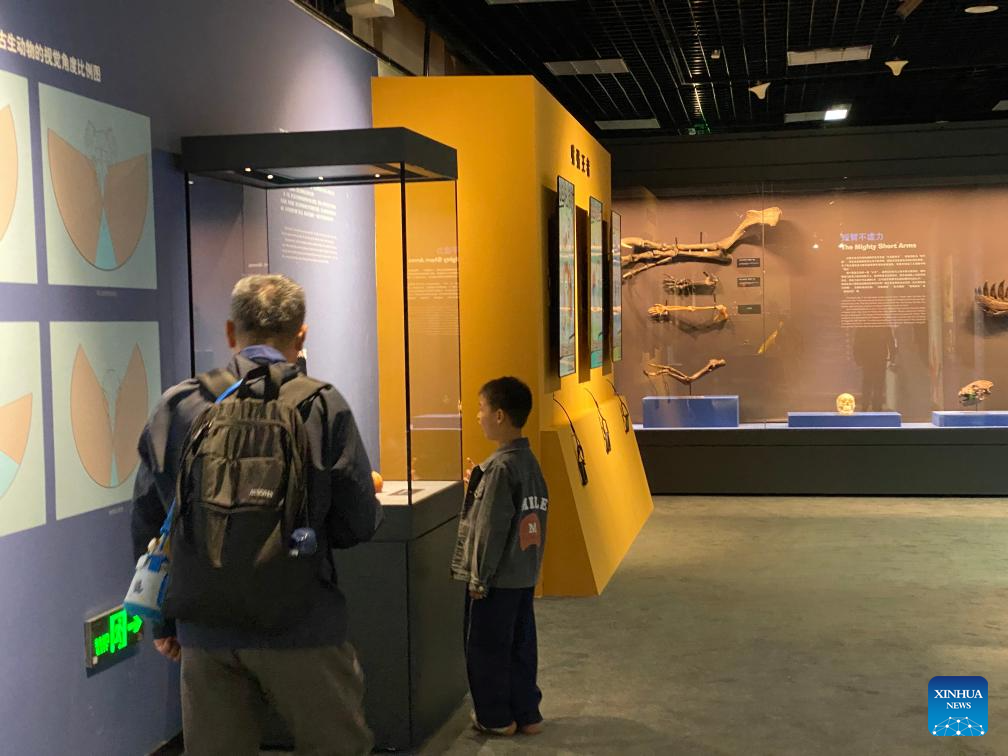
People visit the "A Special Exhibition for the King of Dinosaurs" at the Natural History Museum of China in Beijing, capital of China, April 28, 2026. "A Special Exhibition for the King of Dinosaurs," a blockbuster event that pairs two authentic Tyrannosaurus rex (T-rex) skeletons from Germany with an unprecedented gathering of China's own ferocious tyrannosauroids, has opened at the Natural History Museum of China in Beijing. The show runs through Oct. 11. (Xinhua/Luo Xin)

People visit the "A Special Exhibition for the King of Dinosaurs" at the Natural History Museum of China in Beijing, capital of China, April 28, 2026. "A Special Exhibition for the King of Dinosaurs," a blockbuster event that pairs two authentic Tyrannosaurus rex (T-rex) skeletons from Germany with an unprecedented gathering of China's own ferocious tyrannosauroids, has opened at the Natural History Museum of China in Beijing. The show runs through Oct. 11. (Xinhua/Luo Xin)
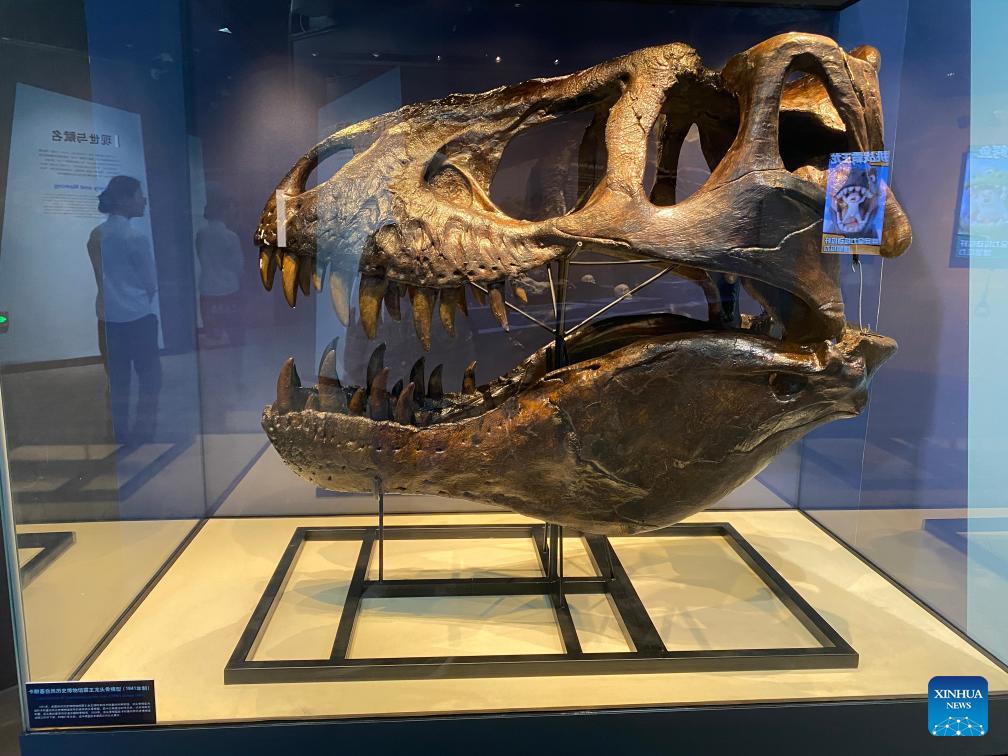
This photo taken on April 28, 2026 shows a skull model of a Tyrannosaurus at the "A Special Exhibition for the King of Dinosaurs" at the Natural History Museum of China in Beijing, capital of China. "A Special Exhibition for the King of Dinosaurs," a blockbuster event that pairs two authentic Tyrannosaurus rex (T-rex) skeletons from Germany with an unprecedented gathering of China's own ferocious tyrannosauroids, has opened at the Natural History Museum of China in Beijing. The show runs through Oct. 11. (Xinhua/Luo Xin)


